

Almost every needle through finger injury shares the same shape. The sewist is guiding fabric with a fingertip close to the presser foot, something breaks concentration, and the foot pedal gets a fraction more pressure than intended. At even a modest speed a domestic machine drives the needle several times per second, so there is no reaction time available. The hand does not get pulled in; it is simply already in the wrong place when the needle comes down.
Two situations account for a disproportionate share of incidents: manipulating small or bulky pieces where fingers must work close to the needle, and changing needles, threading or clearing a jam while the machine is still powered and the pedal is live.
Guarding at the point of operation
Industrial safety practice treats the needle area as a point of operation requiring a physical barrier. In its guidance on sewing machines, the US Occupational Safety and Health Administration explains that the principal hazard is the operator inadvertently allowing a hand into the sewing area where a finger could be pierced, and that a barrier guard should as a minimum enclose the area from the fabric up to the height the needle point reaches at its maximum. The same guidance addresses drive wheels and belts beneath the table, which should be fully enclosed.
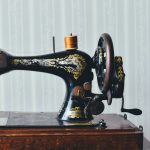
Many domestic machines ship with a small clear finger guard attached to the needle bar or presser foot shank. It is frequently removed on day one because it obstructs the view, and it is worth reconsidering that. Where a guard genuinely interferes with a technique, a magnifier or better task lighting often solves the visibility problem without removing the barrier.
Speed limiting is the other control worth using. Many machines have a maximum speed slider independent of the pedal. Setting it low for detailed work, for topstitching around curves, or when teaching a beginner reduces both the chance of a lapse and the depth of any injury.
Habits that reduce risk
- Guide fabric from beside the presser foot, not from in front of it, so fingers approach the needle from the side rather than travelling towards it.
- Use an awl, a stiletto, a bamboo skewer or tweezers to hold small pieces and feed thick seams instead of fingertips.
- Switch the machine off at the power switch, not just lift your foot, before changing a needle, clearing a jam, changing a foot or removing thread from the hook race.
- Keep the pedal where a pet, a child or a dropped item cannot press it, and unplug the machine when you leave the room.
- Stop when you are tired. Fatigue and rushing to finish a seam are common features of these incidents.
- Replace bent or blunt needles. A needle that deflects can strike the plate and shatter, sending fragments upward.
If an injury happens
This article is informational and is not medical advice. A sewing machine needle puncture is a penetrating wound that may carry fabric fibers, lubricant or metal fragments into the tissue, and part of the needle can break off and remain inside the finger. Even injuries that look minor warrant professional assessment, because the visible entry point tells you very little about what is underneath.
Published clinical literature makes the point clearly. In one documented case, a traumatic finger injury from a sewing needle led to Nicolau syndrome with deep necrotic ulceration, requiring hospitalisation, repeated surgical debridement and around eighteen weeks of treatment before the wound healed. That is an unusual outcome, but it illustrates why a needle puncture is not automatically a trivial injury.
Do not attempt to extract an embedded needle or needle fragment yourself, and do not rely on internet instructions for wound care. Seek prompt medical attention from a doctor, an urgent care service or an emergency department. Bring the needle or the broken pieces if you have them, since the size and type help clinicians locate anything retained. Tetanus status and infection risk are matters for a clinician to assess, not for you to judge.
Treat prevention as maintenance
OSHA’s overview of the apparel and footwear sector groups sewing hazards together under machine guarding and ergonomics, and the agency’s guidance on machine guarding focuses on recognising and controlling amputation and contact hazards on powered equipment. A home sewing room is not a factory, but the logic transfers: keep the guard fitted, keep the speed appropriate to the task, power down before you put your hands near the needle, and stop before fatigue makes the decision for you.